Monday, May 27, 2019
The 24th to 21st Centuries B.C
The ending of the best phase of Ebla’s survival was because of its damage by an Akkadian ruler, almost definitely Sargon, though the grandson of Sargon’s Naram-Sin claimed liability. It can be well that one or the other of these leaders believed that the monarch was taking too dominant, to point where it endangered Akkadian territorial goal west of Euphrates, or at any case refused to assist with the Akkadians within the western enterprises.
However, Ebla’s lifespan was a remote from an end. This had the initial new lease of the life when the modest new settlement, chosen by Mardikh IIB2, has been built at the on northern side of the site subsequent with the Akkadian demolition. The most important place of the phase, now named as the ‘Archaic Palace’, has been possibly the residence of the new or the revived line of the local kings, probably collaborators if not juniors of the leaders of this Ur III kingdom, heir to the Akkadian kingdom.
However, the recent city was a short-lived. This has been destroyed too, about 2000, at about the time this Ur III empire has been completed, and probably by the similar agents. Ebla would climb again. As it has been seen, this was to own at least a major renewal before the abandonment and final decline.
The Amorites
In year 2004, it has been shattered—not, as it takes place, by these Amorites, but by the invaders from the southwestern Iran named as Elamites. The instances were ripe for development. Amorite chieftains shifted quickly to fill-in the force vacuum in the area left by an Elamite victory, placing themselves up as the rulers of the number of Babylonian towns previously subject to this Akkadian and the Ur III kings, with Larsa, Babylon, Marad, Kish and Sippar.
Monday, May 20, 2019
Evidence of existences and deathstyles
First, artistic rebuilding of the Koszyce interment from the phenotypic character inferred from an ancient genome. Second, the Schematic demonstration of the burial with the pedigree plots illustrating the kinship relations. Third, kinship networks from a kinship coefficient.
The report in Newsweek detailed that the scientists find out “four from the individuals were brothers, however, they did not all allocate from the same mother, although the similarities from the two women’s DNA recommends that their mothers might have been related.” Lastly, the lacking of older males from the grave, excluding one father, directed the writers to suggest that those were the ones that buried the women with their kids in the grave.
Battle for the Resources on the Planet
The kinds of injuries presented gave the writers to think that those people had been detained and executed, instead of having been killed battling, and this is from the scientists, “It might fit the broader framework of violence in between competing teams at the time, wherein the women and the children were usually taken as captives.” These authors speculated that the men might have been absent when their children and their partners were captured and later on being killed by the rival group.What has been identified of as the Globular Amphora society is mainly taken from its interment in cists and pits. The grave offerings, with animal parts like the pig's jaw and stone axes had been found towards the skeletons of the entire oxen. The archaeologists have even located the pairs of cattle escorted with by grave gifts.
Tuesday, May 14, 2019
The Modern day Metamaterials
The man-made metamaterials have been originally synthesized in the laboratory in the year 2000 by using the highly conductive metal such as copper or gold in some particular arrangements, such as the layered lattice structures. It has been developed for a diversity of application such as the making of ‘super lenses’ which are able to view objects in a much smaller scale, and then reduced the impact of the earthquakes on buildings.
The ArsTechnica informed that when the researchers compared the present day metamaterials with a structure of particular Roman monuments, they discovered that the patterns within the prehistoric, Roman buildings are very, very closely in resemblance to metamaterials and can therefore have sheltered those structures from possible earthquakes.
Mr. Stephane Brûlé, the civil engineer and also one of this study’s authors, had performed with the group of engineers from the Lyon based industry Menard and with the investigators from the Fresnel Institute in the Marseille, some few years back to make a big scaled seismic cloak through drilling a collection of burials within the soil. Then on, he became aware that the Gallo Roman Theater that he visited while he was on holiday at Autun, France, had similar foundational structure.
Did those Romans already knew about that seismic cloaking possessions of such array? It seems to appear that as the similar pattern was applied in the construction of many Roman monuments, such as the many theaters and the amphitheaters. There is also the image of the Colosseum that has the layered lattice structure which is similar to metamaterials.
Saturday, May 11, 2019
The smashed Mesha stele
Though, there is a drawback with this Mesha stele tablet, which is, it’s being broken. The stone draws closer into the control of some Bedouin and in what is known now as Israel and they give to sell it with some of the European archaeologists that have made offers for the inscribed marble. The haggling showed to the argument and with their anger, these Bedouin smashed out the tablet. Thankfully, most of the rubbings were created of the tablet just before it has been shattered. But, due to the condition of the Stele, it became really hard to decode and for about hundred years, the researchers have been attempting to create a sense of rubbing and remains of basalt.
This Israeli team cut altogether the proof from the tablet that is written in the language not different in the ancient Hebrew. Above all, they concentrated on 31st line of the inscription, wherein the letter ‘B’ may clearly be read, however the rest of its word has been erased.
The Line 31, close to the base of this Mesha Stele, and this is from the drawing of Mesha Stele or the Moabite Stone made by Mark Lidzbarski and published 1898.
This became traditionally thought to point out beth or the house and was then seen as the reference to House of David however, this interpretation had been challenged ever since the 1990s. In the LiveScience, it is reported that ‘Finkelstein with the two colleagues considered that it stood into something else… Balak’.
Tuesday, April 30, 2019
Maya Figurine Workshop
Way back in the year between 750 and in 900 AD, this archaeological site has been situated at the main center of ceramic figurine production. Based on a paper that was published in a National Science Foundation, being discovered in the massive undisturbed state, the scientists studying in that workshop hopes that they’ can be able to relate “figurine production and then have it exchange with the other economic actions that occurred here, then, the relationships those producers maintained together with the local and the far-flung Mesoamerican teams.”
The documents in the Science Magazine talks about the “sheer quantities of ceramics” detailed that in a single burial heap “7,000 sherds in every cubic foot of mud” were discovered. What is more, the whole mound was discovered to have the “astounding sum of 15 million remains” with the fragments of some “500,000 former intact ceramic vessels.”
The quantities informed the researchers that millions of vessels were smashed to remains by either the prehistoric city’s own residents, and by invaders, and everyone served as the physical evidences of not only a region’s huge populace, but they also talk about its turbulent outline of collapse, reconstruction and revival.
The Mayan ceramics are discovered in the mound outside of the Coban in Guatemala.
What do all of these Mayan Ceramics is telling us?
Rationally, despite its fundamentals in the Central American and ancient Mexican economy of a Maya, Aztec, and some other Mesoamerican cultures, a district in which a workshop has been discovered had never been officially investigated by the archaeologists.Wednesday, April 24, 2019
The Twelve Disciples of Ireland with their Legendary Miracles
These original Twelve Apostles of the Christian religion were accountable in taking the devotion and distributing it crossways the Mediterranean World. The Twelve Apostles that were among the first Judean supporters of Jesus. The lesser known group of twelve saints pertains to as the apostles were the 12 Apostles of Ireland that were recognized for their learning of the Bible together with their devout role and lifestyle in spreading Christianity within Ireland. These Twelve Apostles from Ireland all learn under the similar, Saint Finnian of Clonard.
The 12 Apostles of Ireland and the School from Clonard
The school or ministry of Clonard prospered during the Saint Finian’s life span and it was stated that in single time there were a supposed 3000 students. The People would congregate from all around Ireland and in different places to hear from a saint and hear his lectures and sermons. Among these supporters were the twelve men who then later called Ireland Twelve Apostles.The 12 of the most popular of Saint Finian’s learners were the following:
- St. Brendan of Birr
- St. Bendan of Clonfert
- St. Ciaran of Saighir
- St. Ciaran of Clonmacnois
- St. Columba of Tir-da-glasi
- St. Columba of Iona
- St. Canice of Aghaboe
- St. Lasserian mac Nadfraech
- St. Mobhi of Glasnevin
- St. Ninnidh the saintly of Loch Erne
- St. Ruadhan of Lorrha
- St. Senan of Iniscathay
These men were identified for having established churches, monasteries, and being wonder workers and there are sampling stories being told regarding them which have been forwarded on through the centuries.
Tuesday, April 23, 2019
The results of a Viking Shipwreck had been processed for further learning
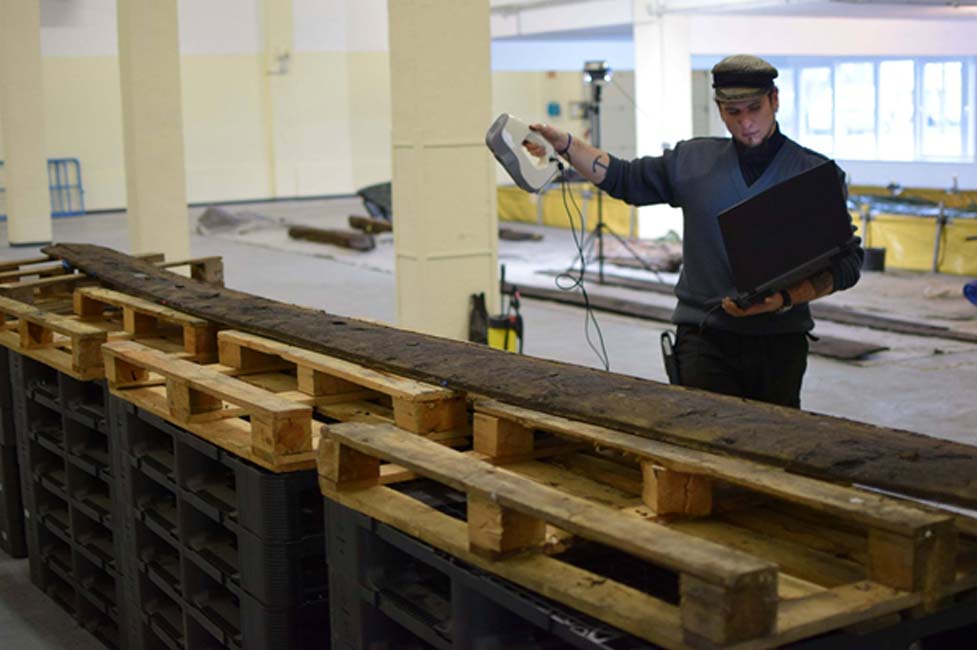
During the annotation procedures, the experts have that digital textured meshes with the real physical lumber of that Viking shipwreck.
“Following these two actions, it created a 2D technical drawing for every the timber, one in a time, in a complete full detail. The drawings are essentially distilled editions of 3D models, illustrating only the interpreted data that is related to researchers, with the timber outline and cross-sections in showing its shape, and color-coded polylines illustrating the different characteristics being annotated on the lumber in Rhino. Through having the 2D technical drawings of the timber, some other researchers may comprehend the timber in just a glance,” said by Van Damme.
“The best advantage of Artec Eva was, in comparing to the Photogrammetry, it was even more of a user friendly, which means that even the populace with relatively tiny experience functioning with the 3D scanning would bear out the documentation, and it was more ‘fun’ and more ergonomic to scan timber this way, instead of taking the 300+ close up photos of every timber from an awkward angles,” said by Van Damme.
The technical drawing, together with the 2D views of textured meshes of timber and wrote descriptions of every one were added to Timber Catalog in the end of a published report, and it has permitted the researchers to examine every timber in details. The Timber Catalog contained the legend that describes what the different dyes on the technical drawings referred to.
The technical drawing of the Viking wreckage was added to Timber Catalog in the end of a published report that allowed researchers to study every timber in details.
Subscribe to:
Posts (Atom)